Как преодолеть ошибку планирования (planning fallacy)
It is human nature to underestimate the amount of time and effort it takes to complete a task—from anything as simple as walking the dog to something as complex as completing a project. People generally want to remain hopeful about a positive outcome, and this is a great quality to have as a person. But as a project manager, this kind of optimism can also be a deficiency, especially during the planning phase of a project. Let’s examine a theory known as the planning fallacy to better understand how to set yourself up for success in the planning phase.
The planning fallacy and optimism bias
The idea of the planning fallacy was first introduced in a 1977 paper written by Daniel Kahneman and Amos Tversky, two foundational figures in the field of behavioral economics. The planning fallacy describes our tendency to underestimate the amount of time it will take to complete a task, as well as the costs and risks associated with that task, due to optimism bias. Optimism bias is when a person believes that they are less likely to experience a negative event. For example, when you are planning to walk your dog in between meetings, you might think that you can do it faster than you actually can. Optimism bias is what tells you that you are going to be able to walk your dog without being late for your next meeting. If you don’t consider things that might affect the time it will take you to walk your dog—the weather, the chance of them running into another dog and wanting to play, or the fact that they frequently get distracted while sniffing around—you might be late for your next meeting, or you might miss it altogether!
Avoiding the planning fallacy: A case study
Think about the planning fallacy in relation to yourself as a project manager. If you have planned massive efforts in your project plan with an optimism bias, this planning fallacy could have a major impact on your project execution. You could set your team up for failure by not giving them enough time to complete their tasks, causing work to have to be redone or missing opportunities to execute the project more efficiently.
Let’s examine how this happens. David is a project manager responsible for a home construction project. Let’s check out his Work Breakdown Structure (WBS):
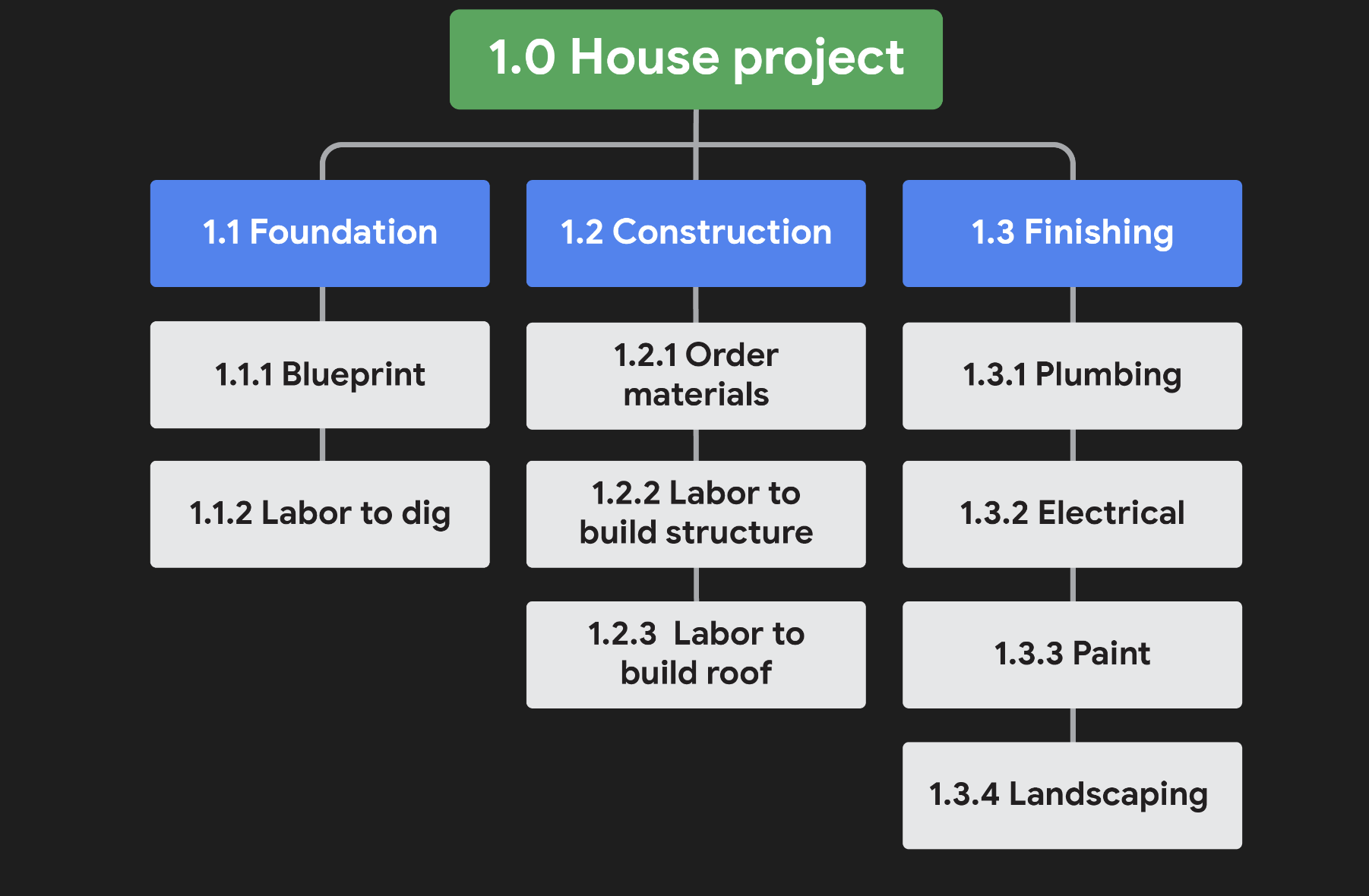
Working through his plan, David knows that certain things need to happen for the house to be completed. He has to order materials, the materials have to be delivered, the contractor has to actually build the house, and there needs to be time for completing finishing touches and adjustments. The time estimations for those major tasks might break down like this:
| Task | Estimated Duration |
|---|---|
| Foundation | 2 weeks |
| Construction | 4 weeks |
| Adjustments | 4 weeks |
After creating a WBS and a time estimation chart, David estimates that the construction project will take a total of ten weeks. This sounds perfect because it meets his delivery requirement. If David is unaware of the planning fallacy, he may think his plan is solid and that his team is on their way to building the house within the target timeline!
Fortunately, David is mindful of the planning fallacy. He examines the time estimates more carefully. He considers risks like weather delays or crew members calling out sick, which could set the project’s completion date back. He meets with his team members and other stakeholders to help him uncover other possible risks that could affect the project timeline. After carefully gathering information, he adjusts the time estimates, adding task buffers to some of the project tasks to account for the potential risks.